[jwplayer mediaid="2068"]






[jwplayer mediaid="2068"]

Our fellow mass customization researcher Golboo Pourabdollahian is conducting a study on MC and sustainability. For this study Golboo is asking for your help:
“Dear colleagues,
May I ask for your kind support for my PhD research?
My research focuses on the fact that how we can make mass customization more sustainable in footwear industry. In this regard I am collecting data to map possible impacts of different Mass Customization enablers on environmental sustainability at the example of the footwear industry.
Therefore I kindly ask you to evaluate a number of relationships between MC enablers and outcomes by responding to a brief survey. You can reach the survey easily by clicking on the following link: goo.gl/so8yY
The survey will take about 10-12 minutes of your time.
If you have any questions, please feel free to contact me at [email protected]
Thanks a lot for your support!”
APMS is one of the major events and the official conference of the IFIP Working Group 5.7 on Advances in Production Management Systems.
For the last several years, APMS has been a major event and the official conference of the IFIP Working Group 5.7 on Advances in Production Management Systems, bringing together leading experts from academia, research and industry.
This year’s conference will offer a special session on Customization in service oriented manufacturing.
In a global and competitive context manufacturing, especially in developed economies, is submitted to great market pressures in order to stay competitive with manufacturing in developing economies, such as China and Brazil. To find a way out, they try to create more advanced products and services which are innovative and better fitting to customer needs. Adding services on products to support and differentiate their offering, it brings new challenges and opportunities for manufacturing. This session is proposed to fill the gap in industries in which offering a mix of products and services is a key competitive factor for manufacturers and try to raise the discussion to better understand how individual’s needs have to be fulfilled in this context.
Though mass customization, as one of the solutions for recent customer-oriented environment, has been discussed frequently in manufacturing and fragmentally in service sector, it has never been targeted in product-service context such as service oriented manufacturing. One of the fundamentals that this session is looking forward to answer is to find out if and how mass customization can impact on manufacturing service ecosystem and what are its opportunities and challenges.
To sum up, this session is aims to discuss the following topics (but not limited to these topics):
• Manufacturing service ecosystem performance
• Customer role and impact on manufacturing ecosystem
• Ecosystem development
• New roles, approaches and tools for catalyzing the pervasiveness of product-services
• Manufacturing Service Innovation Ecosystem
For more information, please contact Marco Taisch or Mahnoosh Zebardast, or go to this website for more information.
Looking forward to seeing you there.
Next week, on February 5th & 6th, Milano Mass Customization Workshop 2013 will take place in Politecnico di Milano Management School (MIP). The workshop is a joint effort of Politecnico di Milano and RWTH University of Aachen. It provides a unique opportunity for researchers and practitioners interested in the field of mass customization, personalization and co-creation to attend interesting talks given by experts and exchange ideas about future of research and collaborations in this field.
The objective of the workshop is to provide the opportunity for attendees to get inspired by different research insights in the field of mass customization such as technologies for co-creation, service customization and sustainable mass customization. Moreover, the workshop aims to facilitate exchanging ideas and inspiring and getting inspired about the future trends along with potential steps to be taken by research institutes and industries. It aims to provide a collaborative environment to initiate possible cooperation among different universities and industries as well. Besides, opportunity of networking is always an objective too!
There will be also a doctoral workshop offering PhD students the possibility to present and discuss, receive feedback, and exchange comments and views on their doctoral research in an inspiring academic community of fellow PhD students, experienced researchers and professors.
For more information click:
[jwplayer mediaid="1738"]
By: Franco Cavani, Micaela Groppelli & Fred
Download this information as PDF:
A resilient enterprise has the capability to respond rapidly to unforeseen disruptions. It is the ability to bounce back and, in fact, to bounce forward with speed, determination and precision. Enterprise Resilience is the next phase in the evolution of traditional, place-centric enterprise structures to highly virtualized and customer-centric structures.
A resilient enterprise effectively aligns its strategy, operations, management systems, governance structure, and decision-support capabilities so that it can uncover and adjust to continually changing risks, endure disruptions to its primary earnings drivers, and create advantages over less adaptive competitors.
In environments characterized by discontinuous changes and uncertainty, enterprises respond by bolstering their agility and flexibility. Resilience is the ability to respond to the ups and downs of the business cycle or to quickly rebalance product-service mix, processes, and the supply chain, by bolstering enterprise agility and flexibility in the face of changing environments.
A key issue faced by organizations today is the challenge to deliver the products matching the needs of individual customers, in different geographical markets, at any time, and preferably individually customized, as cheaply and as quickly as possible. The mass customization strategy has been suggested as a way to address the challenge of providing individual products with mass production efficiency. While there has been plenty of research on the enablers in manufacturing and sales of such a strategy, companies still fail to profit from mass customization as it is not included in a networked environment that allows the company to profit from mass customization along the entire value chain. New methods and tools are needed to enable enterprises to respond robustly on customized market demand scenarios, within required cost and time restrictions.
Resilience it is not about responding to a one-time crisis, or just having flexible processes. It is about continuously anticipating and adjusting to discontinuities that can permanently impair the value proposition of a core business. It requires innovation with respect to those organizational values, processes, and behaviours that systematically favour perpetuation over innovation, renewal being the natural consequence of the enterprise.
Potential topics include, but are not limited to: Resilient Production Planning, Resilient Order Promising Process, Resilient Production Scheduling, Resilient Distribution Planning, Resilient Multi-site Production Design, Delivery Reliability, Efficient Mass Customization,Resilient Process Configuration, Even Management, Performance Evaluation, Risk Assessment, ICT for Enterprise Resilience, and Best Practices on Enterprise Resilience, etc.
The APMS 2012 international conference was held in Rhodes, Greece 24-26 September. The conference attracted more than 250 delegates from different countries all over the globe exchanging their insights about advances in production management systems. Apart from the parallel sessions of conference, there were 11 special sessions to provide the opportunity for experts to focus more on specific topics and research areas.
Two special sessions were dedicated to Mass Customization, as proposed by Politecnico di Milano. It was the first time in the history of the conference that Mass Customization received this much attention. The two special sessions were titled “Design for Mass Customized products and services” and “Manufacturing and supply chain in a Mass Customization environment”.
From the many submitted papers, 7 papers were allocated to either one if the MC special session. These papers covered a wide range of topics in the field of Mass Customization, such as configurators, process design, modularity, production system modeling, business model, simulation based design, etc.
The MC special sessions at the APMS 2012 presented itself as a meeting point for academia and industry. Apart from presentations from reputable institutes (e.g. RWTH, ETH, Polimi, University of Washington, SINTEF, and SUPSI), there were interesting presentations from Siemens and TXT e-solutions addressing application of mass customization in industry.
Special MC session at the APMS 2012
In general, conference was a successful event for Mass Customization, not only from scientific point of view but also from networking point of view. The conference evolved into a happy ending as the Burbidge award for best APMS 2012 paper went to one of the papers presented during the MC special session “Manufacturing and supply chain in a Mass customization environment”. We congratulate Prof. Dimitris Mourtzis and his co-authors with this award for their paper ”Simulation-based design of production networks for manufacturing of personalized products”
Recently, the International Labour Organization released a report titled: “Working towards sustainable development: opportunities for decent work and social inclusion in a green economy“, Geneva- 2012, in which authors investigate the synergies between sustainability dimensions and argue that environmental degradation has negative impact on economic and social dimensions of sustainability, such as the costs of wasteful production, the destruction of jobs, and income loss. Moreover, the shortage of natural resources leads to escalating prices of goods including food and energy which exacerbates poverty and inequity. In this regard, green economy provides tremendous opportunities to improve all sustainability dimensions. The report highlights success factors of the shift towards sustainable development, the important role Small and Medium Enterprises (SMEs) play in this respect, and in particular underlines the importance of a comprehensive policy to push social considerations forward.
One of the recommendations is the development of integrated frameworks to measure and improve sustainability performance.
This is exactly what has been done in S-MC-S project. A key result of the S-MC-S project is an integrated assessment model (developed by ECN, SUPSI and PoliMi), addressing sustainable mass customization, although applicable also to conventional production and businesses. The assessment model is developed to support SMEs in assessing their current and future situations. It integrates economic, environmental and social life-cycle factors into a single framework, providing a comprehensive overview within the sustainability dimensions, and links this back both to the business reality as well as the product development activities. A link to business modelling supported by business related metrics supports the SME in taking the appropriate decisions, and further developing a sustainable business. The integration of the model within design tools ensures support to designers at practical level.
The model has been developed in close collaboration with industrial partners, and in the course of the S-MC-S project, will be further tested against practical situations.
Next week SUPSI will be in Rhodes, at the International Conference on Advances in Production Management Systems, to show one of the S-MC-S project results. Rhodes is a very nice place and the conference is a very good occasion to present how we are putting together many little pieces of the big puzzle within the project. We will present a paper about the supply chain modeling and simulation tool which brings us to the very heart of the project concept that is supporting concurrent design of a mass customized solution space while controlling in real-time its sustainability performance.
To support this holistic approach we have developed an integrated tools landscape. Obviously, designing for mass customization while taking care of the sustainability of the entire supply chain means the collection of enormous amounts of data, which must happen during the design phase. Taking care of the sustainability performance after completing the design simply is too late to consider any meaningful change. Our tools landscape is a set of new tools that integrate seamlessly with those the company already has and uses.
At APMS 2012 our focus is on the supply chain. We will present a tool, that we have been developing, to support you in:
Our paper will be presented by Marino Alge on the 25th September during the Manufacturing and Supply Chain in a Mass Customization Environment session. Hope to see you there.
MCKN is proud to introduce a new partner project on the platform: S-MC-S: Sustainable Mass Customization, Mass Customization for Sustainability.
To adapt to global competitive pressures, European Industry must develop methods and enabling technologies towards a personalized, customer oriented and sustainable manufacturing. To this end, S-MC-S vision is to define and research a new production paradigm, Sustainable Mass-Customization.
The capability to produce personalized goods with near mass production efficiency goes widely by the name of Mass-Customization. S-MC-S addresses Mass Customization as one of the main driving forces to achieve effective Sustainability, and thus a key enabler to implement this envisioned personalized sustainable production.
Indeed, manufacturing is growing beyond the economic context, into a social and ecological phenomenon, motivating companies to move towards sustainable manufacturing: manufacturers are thus demanded to merge the need to be reactive towards customer needs and wishes (customized products), with the requisite to be proactive towards ecological and environmental impact (sustainable products).
S-MC-S addresses this challenge by promoting 4 RTD Pillars:
Design Tools: defining methodologies and tools capable to manage growing complexity of product, production and supply chain configurations imposed by MC implementation in a networked environment.
Assessment model: defining the assessment model needed to evaluate the impact of production systems and different supply chain configurations.
Business Model: defining the framework and strategies for creating economic, social and ecological value through the systematic implementation of S-MC-S paradigm.
New specific MC technology: researching pilot MC enabling technology in 3 different sectors, to support manufacturing transition towards sustainable MC (leather; furniture; stone)
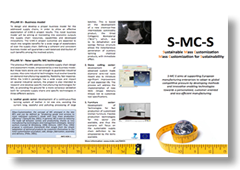
For more information :scms, or download the project flyer:
S-MC-S is a 7FP, funded by the European Commission (Grant Agreement No: FoF.NMP.2010-2 260090 - S-MC-S)