The MyWear project will be presented at the ICE 2014 conference during a workshop entitled: Embedded sensors, smart and innovative services for personalised products.
Join us for the workshop on Monday 23 June, from 14.00 to 15.30. The full ICE Conference takes place on 23-24-25 June 2014, in Bergamo, an inspiring town in the middle of Lombardy Region, in Northern Italy.
A short description of the workshop scope:
Today consumer goods like clothing, footwear, sportswear have the untapped potential to escape from being traditional products by mean of innovative services like sensing the status of customer well-being, functional materials etc to offer safe and healthy conditions for applications like work and sport. This paper session aims to discuss innovative approaches to make Smart product concepts into reality. For example, how to turn rigid electronic parts into stretchy, smart clothing material. How to interact with services and technology through clothing. Can we go beyond swiping a hand across a coat sleeves to adjust the volume of a connected music player? What are the services to be created upon the data collected through integrated sensor technology, for the public in general but specifically for elderly, obese, diabetics and disabled? To what extent does new generation of green, safe, healthy and smart work wear and sport wear products need to be customised to individual needs?
Full program is in development. We will post it when available.
Chair: Prof. Luca Canetta
Co-chair: Rosanna Fornasiero
Short description: Today consumer goods like clothing, footwear, sportwear have the untapped potential to escape from being traditional products by mean of innovative services like sensing the status of customer well-being, functional materiasl etc to offer safe and healthy conditions for applications like work and sport . This paper session aims to discuss innovative approaches to make Smart product concepts into reality. For example, how to turn rigid electronic parts into stretchy, smart clothing material. How to interact with services and technology through clothing. Can we go beyond swiping a hand across a coat sleeves to adjust the volume of a connected music player? What are the services to be created upon the data collected through integrated sensor technology, for the public in general but specifically for elderly, obese, diabetics and disabled? To what extent does new generation of green, safe, healthy and smart work wear and sport wear products need to be customised to individual needs?
The session specifically welcomed contributions on:
• Wearable sensors and technologies
• People-driven social innovation
• Innovative methods and tools for product/service design/engineering
• Sustainable and eco-friendly smart products and services
• Human-centered design and manufacturing technologies
• Business models and new supply chains for consumer goods products
• Technology and Business Transformation
• Sustainable mass customisation strategies
The workshop is supported and leaded by members of the IMS MTP Initiative YourGoods. The IMS-MTP initiative YourGoods has been created to foster the collaboration among various FP7 projects (CoReNet, Fashion-able, MyWear and Prosumer.net) and partners from Europe, Mexico, USA, Switzerland and Korea. The aim of the MTP YourGoods is to extend the scope of each single project sharing common research themes around Consumer Goods industry applications.
Submissions for this workshop, please send before 10 February an extended abstract to Prof. Luca Canetta or myself.
The MyWear project on customised green, safe and healthy consumer products has achieved an important intermediate deadline; it has designed and implemented the Data Integration Platform (DIP). Download the MyWear_IntegrationPlatform flyer to have a brief overview.
The DIP offers the following functionalities:
- Collect data from the scanning
- Monitor systems
- Store the data according to the human body data model and represent it in terms of: a) formats required by adaptive production systems and processes, and b) functionalities for customer-centric sensors-enabled value-adding services

Within the MY-Wear solution portfolio, the DIP plays the role as the system supervisor. It manages the data arriving from different body wearing devices and provides the logics to store and aggregate the data, and make them available to various system components and services.
The DIP can integrate with a wide variety of data sources and tools to offer added valued comfort, safety and health related services to the end-user and/or other stakeholders, such as for example family members interested in tracking the health of the end-user, or specific alarms being send to family and/or physician in case values exceed predefined treshold values.
The DIP is designed to support the following scenario:

Scenario 1: The most basic scenario depicts the information based on the data collected from different sensors being made available to the user via the smart phone. For example, the user is able to see his hart rate, blood pressure or temperature.

Scenario 2: In the extended use-case the data collected is routed via the integration platform, where the data is processed by external services or combined with external data sources to provide information for more informed decision taking.

Scenario 3: The advanced scenario depicts the data provided to third party stakeholders, such as family members or physicians. After the data is collected by the smart phone, it is processed and routed by the integration platform, after which aggregated information is offered to stakeholders.
The DIP offers a complete API offering integration possibilities to a large range of service providers.
CeBIT is the world’s largest trade fair showcasing digital IT and telecommunications solutions for home and work environments. The key target groups are users from industry, the wholesale/retail sector, skilled trades, banks, the services sector, government agencies, science and all users passionate about technology. CeBIT offers an international platform for comparing notes on current industry trends, networking, and product presentations. More than 4,000 companies from 70 countries took part in CeBIT 2013, including numerous start-ups.
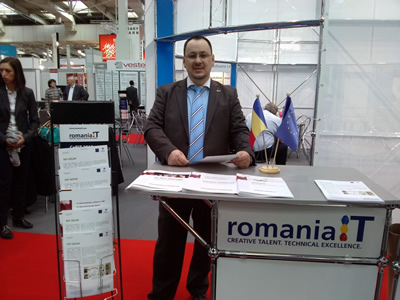
ROPARDO S.R.L. attended like exhibitor at CeBIT 2013 within Romanian Stand and presented the commercial services but also the research capabilities and services. Like an active partner in research projects, ROPARDO took full advantage about EEN-future match (international cooperative market by CeBIT lab and Enterprise Europe Network-EEN) in order to spread and disseminate the information about results from running projects.
The WP6 value-adding services has started with T6.1, to translate main Consumer Requirements into well-defined Service Requirements.
Starting from the collection of outcomes of other tasks e.g. results achieved in WP1 and identified validation scenarios described in D1.3., T6.1 performed an integrated in-depth analysis and evaluation of target group requirements according to the context of use, data to be monitored, identified sensor, and considering the scenarios defined.
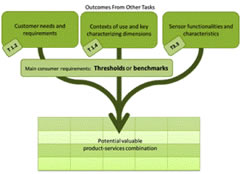
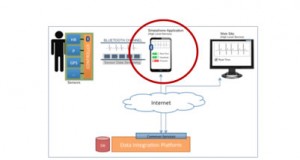
Figure 1 shows the overall idea and concept for value added services. It shows the how user-data collected by a master unit, and is forwarded to the Data Integration Platform (DIP), where the data is safely stored in central databases and made reusable for external applications.
Of the 9 integrated solutions defined in the validation scenarios (WP1), only 4 are possible to develop, which have been evaluated and prioritised. Based on these, the following test cases were analysed:
- Heart rate: Heart rate monitoring for elderly sportsmen
- Fall detection for elderly sportsmen
- Respiratory rate monitoring for elderly workers
- Blood oxygenation monitoring for diabetic workers
- Plantar pressure monitoring for obese workers
The foreseen system architecture (Figure 1) uses a smart-phone as master unit. All selected services will use this master unit both to transmit/receive data to DIP and to directly offer services to the user through new developed applications.

The iTechtStyle Forum focused in stimulating networking among players from the technical and fashion textiles and clothing and also between those and other players belonging to complementary application sectors, always following a spirit of bringing together ideas, potential investors and stakeholders.
The iTechtStyle Forum put all efforts in order to “Make it happen” by helping new business ideas, new projects and new concepts to find its way to market. The ultimate objective was to contribute to the shaping of a brand new textile & clothing industry generation, powered by innovative and high added value products and services.
The iTechStyle Forum, integrated 5 initiatives/areas as shown below:
This event received almost 5 100 visitors (4 629 domestic and 462 international) and 300 exhibitors in different categories, manufacturers clothing man-woman, lingerie, children and textiles.
A showcase of opportunities! The R&D Projects and New Concepts showcase was the place to present and demonstrate R&D projects (starting, on-going or recently concluded) and innovative concepts, both at national and international level. The MyWear project has been present in this space.
The image shown right was contributed by Henrik Søgaard (Ohmatex) to illustrate the activities of WP3: Textile Intrinsic communication layer of which Henrik Søgaard is WP-leader. The image depicts the half of a safety shoe (contributed by Base Protection) to which the stethoscope was added to illustrate one of the project goals of MY-WEAR; collecting real time data from the user and make this available to the physician, caretakers, family members and/or to the user himself.
The objective of WP3 is to design and develop an “intrinsic communications layer” using textile – based circuitry and designed connection points which can be manufactured as standard in work-wear, sports garments and shoes and which facilitates the connection of a wide range of sensors/systems for individual customer specific monitoring solutions.
Currently, development is on-going, specifically on the sensors, and on integration solutions. During a WP meeting end of February, initial sketches and ideas were presented, of which a few are presented below.
We are looking forward to seeing more of the activities and of the solutions explored.
When dealing with research at any level, one of the main risks and challenges to be dealt with is to fit each little step ahead in a broader walk toward success and innovation.News is coming from Valencia where, last 27th and 28th February, the YourGoods event has been held at the Instituto de Biomecánica de Valencia with the participation amongst the others of the MyWear project.
The YourGoods initiative is aimed at sharing the knowledge and experiences gained through different FP7 projects thus extending the scope of each single one on topics like:
- closing the gap between customer requirements and design and configuration of innovative products and services to ensure well-being as well as fashionable goods;
- identification of materials, components as well as industrial technologies to fulfil customers requirements in new flexible and adaptable production systems;
- setting up sustainable supply networks based on distributed and collaborative environments to ensure coordination of actors with different capabilities and competences.
This last event in Valencia, organized by IBV and ITIA-CNR, was a great opportunity for many good reasons. On the one hand, during the first day internal workshop, partners in the IMS-MTP Initiative benefited from networking their projects and finding complementarity research activities and industrial applications in the consumer goods area. On the other hand, the second day public event allowed to discuss the state-of-the-art technologies in design and management of collaborative manufacturing networks with the vast audience of companies and association from the addressed sectors (textile, apparel, footwear, etc.) who promptly joined.
With the participation of partners coming from all around Europe and also from the Mexican and Swiss region of the IMS, this two-day event can be considered a good starting point for a more shared and synergistic evolution of the research aimed to deliver the next generation products.